I’m having Claude go through all the project files for the game I’m designing, which I have no idea if is even necessary.
The problem with most vibe coders, I reckon, is that they treat AI like a black box out of which is shit finished products.
But it isn’t helpful to think of AI as a magical shitbox. You should think of AI (in this context–the coding context) as a wrench. It’s a tool that can be used for a specific purpose.
The only catch is that it’s a multitool, there’s no set list of all the purposes it can be used for, and it’s constantly updating.
So the wrench is learning to be a better wrench.
Which is kind of fucked.

Cool, though.
It still means you need to have a process in mind when you want to design something like a game.
I started all of this my making a proof of concept, which took a day or two because I really didn’t know how to start and I switched from using Codex to using Claude in the midst of setting up. (No good reason for the switch. I’d just never tried Claude and wanted to compare. They are, for my purposes, the same.)
This PoC was just a version of the game that had circles and squares for pieces and a rudimentary keyboard for users to do inputs.
For a lot of this, inputs were like, “Claude, make a keyboard.”
Then, “Make the keyboard wider.”
Then, “Look up the keyboard size of a typical iPhone screen and use those sizes as a reference.”
Then, “Make some placeholder ‘letter tile’ images in five different colors, one for each game element…”
Once I got that set up, we built some test mobs with simple shapes.
The premise of the game, which I’ll explain as we go along here, is that you encounter mobs on a map that give you crossword-puzzle style clues, for which you type in answers. Answering questions correctly does “damage” (the game is not combat-based–you fill a curiosity meter rather than deal damage) and you get loot for beating these mobs.
The loot is trash. Not bad, but actual trash. Like…
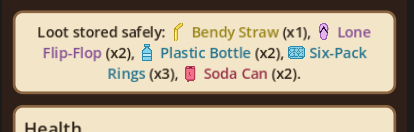
…that.
Anywho, I built a proof of concept and it was fun so I started adding to it.
I’ve been tinkering for a few days now and I’m at a point where, normally, I’d be concerned about some of the changes that have been made and/or if there are any old or outdated dynamics or code chunks that could be “cleaned up.”
I don’t know. I haven’t written a single line of code. All I’ve done is type in the text stuff–questions, answers, what the NPCs say, labels, all the fun stuff that makes the game the game.
Is the code…dirty? Unkempt?
Does Claude need to go back and clean up code Claude wrote?
If so, how often?
Well, I’ll save some suspense. YES, we will need to do that. Audits are 100% necessary. There is absolutely NO way to avoid them. At least not that I can see.
I didn’t know exactly how often to do it, though, especially considering how resource-intensive and time-consuming something like that is.
I asked Claude.
Claude said you should do it after any sort of big change, generally (amongst on other occasions–just about every time you’d think you should), and I’d just finished a big map update (I used an app called Wonderdraft to doodle an island on which my placeholder mobs can wander), so, I thought, let’s make a set of steps we can follow to audit this code and see what we find.
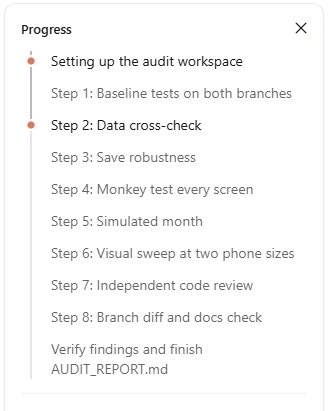
This is what Claude came up with.
I have no idea what this audit will show. I’m not even 100% what it means by “Save robustness” or if we really need to simulate a whole month, considering the in-game economy is an absolute mess.
Worst case scenario, something breaks and we roll back to the previous version of the game.
Best case? Claude takes 2-3 hours to come back and tell me that everything was fine the whole time and that he ended the month of playtesting with 1,000,000,000 gold coins.