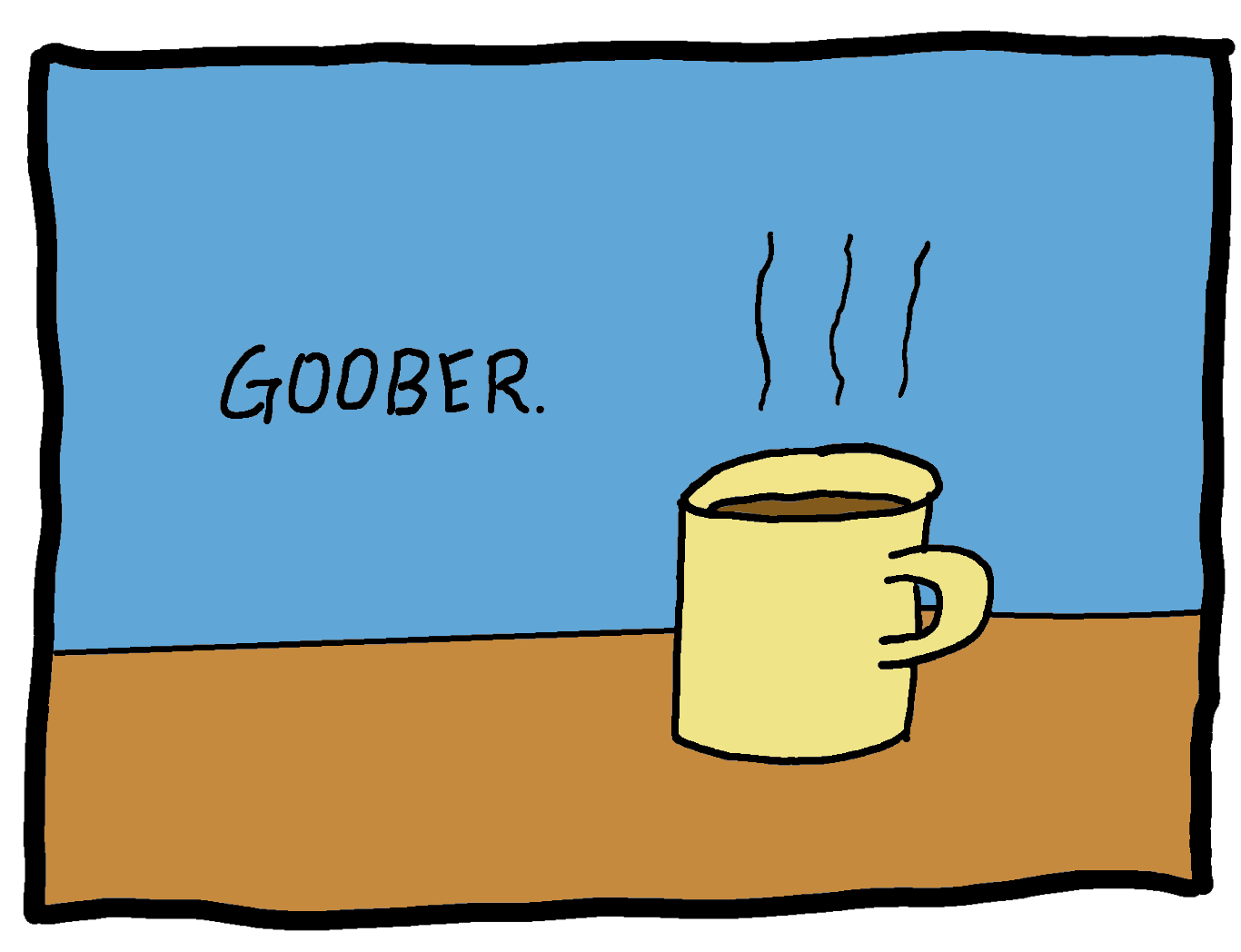
Three dollars times five days a week times four weeks a month is sixty dollars times twelve months a year is seven hundred and twenty which it turns out is too much

I’ve been thinking a lot recently about what it means to be “Put Together.(As in, “Let me put myself together,” or, “That’s a guy who really has it all together.“) It’s a feeling that I like and I assume everyone else likes it, too. Otherwise, why would we all have dress shoes?

Anywho. When I think of being “Put Together,” I always think of Haruki Murakami.

Author of books like 1Q84, The Wind-Up Bird Chronicle, and Kafka on the Shore, Haruki Murakami has become a bit of a literary staple. I had a furious love affair with Haruki Murakami’s books in the 2010s, when I was in Korea and shopping at What the Book, which carried all his Vintage International Editions with covers by John Gall. (I read them all, collected all the different editions. I even had a few written in Japanese, which I couldn’t read but admired.)

I’m a Murakami nut.

Murakami has a few tropes that appear in his works, and one of them is the (usually male) character who loses his current life for one reason or another and is forced to rebuild his life from the ground up in a whole new setting.

Like, a guy has an existential crisis, gets dumped by his wife, leaves his house and job, and then moves out to the countryside where he works at a small-town library. Once placed in his new surroundings, Murakami describes how the character wakes up, how he cooks breakfast, how he gets to work, etc., etc. Murakami might describe the steps involved his getting dressed, how he unwinds after a long day, the restaurant he goes to for dinner, or the turn-by-turn route he takes in going home from work in the evening. All of it is so meticulous and minute and it just scratches some kind of itch that I have. I can’t get enough of it.

I think that itch I feel is the desire to be “Put Together.”

A few years ago, when I first started teaching at my current school, I was trying to set up a routine that would work for me. Sarah and I had just moved into the house we rent and things were … tough. We’d been overseas for so long, we didn’t have any furniture, knew hardly anybody in town, the pandemic had just happened, and both of us weren’t making very much money.

Things were decidedly not Put Together.

Back then, I thought I’d stop in the mornings at a gas station for a quick cup of coffee like I did back when I was student teaching, which was the last time I’d been a teacher in a U.S. classroom. It was a silly thing, but I liked stopping at a little place before the sun came up for a quick cuppa. I liked the silly little interactions I had with the gas station attendant. I liked walking into the school building with a warm paper cup in one hand and my entry badge in the other. I liked to take a little sip, smack my lips real loud, and go, “Aaahhh!” so it echoed down the hallways. Frivolous? Sure, but you’ve got to take pleasure in tiny, pointless, everyday activities. Otherwise what’s the point?

After a few days, though, I did the math, and I realized that I wasn’t making enough money to buy gas station coffee before work. With rent, utilities, gasoline, insurance, groceries … I just couldn’t afford to stop at a f*cking Casey’s for a bullshit cup of coffee every morning. And while having a gas station coffee isn’t necessarily a big part of being “Put Together,” it felt like I was trying to build for myself one of those minuscule Murakami habits only to be told, “Sorry, the coffee from our gas station is for better people than you.”

I’m still bitter about it. Dark and bitter. And aromatic!

Translations & Hand-Holding

The Epic of Gilgamesh isn’t what you’d call a “fun” book, unless you happen to be 4,000 years old or live in the ancient city of Nineveh. And let’s be real. The cost of living has gotten so bad that practically no one can afford that Nineveh rent.

What I tell people about Gilgamesh is that it’s (arguably) the oldest bit of literature humans have and that, on a sentence-by-sentence basis, the whole thing makes you question the very act of translation itself.

I’m normally a huge fan of parsing translated works. It’s an unusual stance, but I enjoy reading translations. They’re a linguistic playground — no translation is ever 100% accurate, so you get to ponder the smallest of details, question every turn of phrase. 

In Gilgamesh’s case, though, it isn’t just a language barrier. There’s also a time barrier that confounds the whole thing.

Example: There’s a part of the story in which Gilgamesh is going to bed in order to have some prophetic dreams while hanging out in the wilderness with his ol’ buddy Enkidu. After some dialogue, the author says…

“Then they took each other by the hand and lay down to sleep…”

As a contemporary reader, I can’t help but wonder, “Why are these two heroes holding hands?” We’re very nit-picky, we readers, and wonder about everything.

If it were a modern story (specifically one written in English), I wouldn’t need to wonder all that much about it. I understand why most modern English-speakers hold hands, and even if I didn’t I could figure it out from context. For Gilgamesh and Enkidu, though, it’s hard to tell. Did people 4000+ years ago hold hands the way we hold hands? Or was there something else to it?

As far as I see it from my desk here in the Teacher’s Plan Center, there are 8 reasons why it might happen, this ancient hand-holding. 

Reasons Why Gilgamesh and Enkidu Might Hold Hands:

  1. They’re pals. Pals hold hands, right?
  2. One of them feels nervous.
  3. They both feel nervous.
  4. They have a romantic relationship.
  5. It foreshadows a later event. 
  6. It’s a different form of nonverbal communication.
  7. It’s a ritual. (Maybe religious?)
  8. It signifies some kind of character development of which modern readers are unaware.

That’s not a comprehensive list — odds are the reason is either so simple as to be not worth mentioning or so ancient that we simply don’t know.

But that’s the fun of it. Or at least that’s how English Teachers get their fun — it’s just amazing to see something as mundane as holding hands turn into this timeless question of narrative detail.

If you want a real answer, though, you’re going to have to talk to someone smarter than I am. You silly people expect me to tell you everything?