Troublesome times & behavioral defiance

At the end of last semester — just before winter break — a troublesome student of mine handed in his final assignment and told me, “I’d better pass this class. Otherwise, I’m coming for you.”

I didn’t feel particularly threatened by it. This student talks a lot, but they’ve never been violent, so I didn’t think there was any substance to what they’d said. However, you don’t get to threaten people.

So, I took the student into the hallway and explained it to them. “You can’t talk to teachers — or anybody, I guess — like you just did. Making threats like that is very serious.” I sent the student to his admin and wrote them up.

All of this happened literally 15 minutes before school got out for winter break.

I took some time before leaving for the day to speak to administration about it; I wasn’t sure what the protocol was for threats, so I wanted to cover my bases and make sure I’d informed everyone who needed to be informed. Admin told me not to worry — that particular student was being moved out of my class. So, I thought, problem solved. Hopefully the student will be put someplace where they can find success.

Except, of course, that wasn’t the end of it. That student simply got moved from one class of mine to another class of mine. So, I’m still teaching them, but at a different time of day.

(Thanks for the help, admin! Shuffling students around like troublesome Catholic priests is sure to solve this issue.)

Yesterday, this student got in some more trouble. They were late for class without a pass, lied about where they’d been, lied about talking to an admin when told to get a tardy slip, lied about having their phone, lied about using their phone while they were supposed to be reading, and refused to stop using their phone multiple times. All of this was within the first 10 minutes of class.

I called for security to get an escort to take this student to the administration office. The student said, “I don’t need an escort. I can walk to the admin office by myself.”

I said, “I’d like to believe you, but you’ve lied pretty consistently today and you have been caught walking the halls several times this week. We’ll just wait for an escort to make sure you get where you need to be.”
Only no escort showed up. We waited for over an hour, but … nothing. The student just sat at his desk. I carried on with the lesson and emailed admin to ask what to do in this situation but heard nothing in response before the end of class.

It is incredibly disheartening. I’m not mad at the student, just as I’m not mad at admin for keeping this student in my class, just as I’m not mad about no security escort showing up.

The cold, hard truth of it is that security was probably busy with other problems and didn’t have time to send an escort. Admin probably kept the student in my class because there was no other choice with schedulingevery student takes English and there are only so many English classes. And this student has problems of their own — I’m sure their propensity for lying is learned behavior that has helped the student in the past. They need more help; they need a classroom with fewer students and a different structure.

This is the kind of student who, if I asked them, “Please write your name on this piece of paper,” would fail the task. Not because they can’t write or anything; it’s more likely something along the lines of behavioral defiance. The student opposes anyone in authority “just because.”

I wish I could say I didn’t have other students with the same issue, but it’s actually pretty common.

Who would’ve thought a country like ours would produce so many people with behavioral disorders?

Balance Beams & Playing the Heavy

I had to give out so many referrals yesterday. About an order of magnitude above the usual number (which is nothing overboard — maybe a handful a week). It was exhausting and just … terrible. I’m not sure how else to describe it.

We recently learned that a significant portion of the students at my high school are “off track,” or missing the credits they need to graduate because they have failed or are currently failing classes, and admin freaked out about it. They sent out a slew of emails, held lots of meetings, and then sent out more emails about the meetings, which required further administrative communication (in the form of emails about emails about meetings). They didn’t say it directly, but the essential message to teachers was: We’re panicking; we need to do something.

There’s a perfectly rational explanation for this perceived dip in student performance — it’s the start of a quarter and grade books only have one or two grades in them. My classes have only had around 2 graded assignments after these first few weeks, so the students’ entire grade is currently based off of a very small sample. I mean, if a student missed one single assignment so far, they’d technically be failing.

It’s the equivalent of a baseball coach yelling at a batter after missing the first pitch of the year because his batting average was too low.

The grades will normalise after we get a better sample of students’ performance. In two weeks, I’d say, things will be closer to normal, with final quarter grades being the truly accurate measurement.

However, in the meantime, I’ve decided to try to help the problem anyway because, A) What if I’m wrong? Maybe there’s another reason why on-track data has slipped, and B) Why not try some new approaches? iI there’s a chance they help, why not give it a whirl?

I decided to focus on a group of students that are often overlooked and brushed to the side: The Barely-Theres. The ones who are at school, but only barely. Those students who do zero work, who contribute about as much as a cardboard cut-out.

In most classes at our school, there are at least one or two students who, for whatever reason, do absolutely nothing. They sit in the back of the class with their head down, don’t respond to questions, don’t turn in assignments, will ignore nearly every instruction, and are perfectly fine with failing the class. You can ask them, “Hey, is everything okay? I notice you’re not doing this assignment. Would you mind telling me why?” And they will just stare blankly at you and/or maybe shrug. Even hit them with an office referral and there will be no change. Email home? No response.

It’s heartbreaking. But in a class of 35 students I can’t spend 10 minutes trying to get little Tommy to read Abraham Lincoln’s Second Inaugural Address when all he’s barely willing to sit up (and even that only sometimes).

This week I decided to spend a little more time with those students. After all, if I can get a few of them to up their performance just a little bit, they’ll be passing, right? It’s good for them, good for admin, good for the school.

Not so “yay” for me, though. It sucks to have to “play the heavy” all day long. I had so many hallway conversations (“I want you to finish this assignment. What can we do to make that happen?”), sent so many emails to admin (“Tommy didn’t come back from lunch–have you seen him?”), wrote so many referrals (“Tommy, after repeated warnings, decided to make a TikTok dance videos in the back of the classroom while he was supposed to be writing a rough draft.”)

I was never mean about it. Just adamant. You will get this work done. I’m sorry, but putting your head down for 90 minutes is not acceptable.

I got a lot of nasty looks, got cussed at, threatened with the ol’, “My mom will hear about this!” gambit. (Which is not at all as frightening as students think it is. Oh, sweetie, I would LOVE to have a chat with your parents. Let’s call them right now!)

On top of having to be confrontational the whole day, I lost instructional time because I had to spend all those extra minutes having hallway convos; doing everything just took a lot longer and I wasn’t able to spend as much time with students who needed more academic help.

By the end of the day I was wiped. Utterly exhausted, both physically and emotionally.

You’ve got to find a balance, but I’m still not sure where that balance is for me. I’m certainly not sure if I can keep this up.

Failing & Meetings About Failing

It’s early in the spring semester at the high school where I teach, which means it’s time to have meetings about failing students.

What a treat!

This year’s crop of Juniors (to whom I teach English) are securely buckled into the struggle bus with their “on track” numbers (the number of students in the class who are on track to graduate next year) falling wayyyy behind other classes. Something like 1/3 of the students are missing required credits.

It’s not that they won’t graduate. It’s that they’re behind.

This isn’t the school’s fault, it isn’t admin’s fault, and it surely isn’t the fault of the parents or the students or the teachers. These are students who went through all the remote-learning pandemic nonsense right when “socialization” was most necessary — in elementary and middle school. It should come as absolutely no surprise that they are struggling; their view of education has been wrecked by years of shake-ups and the whole crap chute of “remote learning.”

The biggest educational detriment provided by the pandemic was, in my opinion, convincing millions of students that they just didn’t need to be at school. They went through years of remote learning, which is wildly ineffective, but they still passed all their classes. Now it seems like many of them (and their families) are questioning the whole institution of public education.

Fair enough. Question away! I say. But you can’t be surprised that over 1/3 of the class isn’t on track to graduate. And we certainly shouldn’t be having meetings where we point fingers and assign blame. “How do we best support students who aren’t showing up?” is a question that most classroom teachers aren’t equipped to answer, and the solutions are probably things that most classroom teachers can’t implement.

It’s not like we can sneak into Billy’s house and set his alarm for him.

When I look at a list of students who are failing my English classes, the unifying factor between them is they simply aren’t coming to school. And, on the odd day when they do show up, they don’t get enough work completed to receive a passing grade.

Example: Last semester, I had a student submit a total of 2 assignments. 2 assignments out of 25. And she still expected to pass! It came as a shock to her that she didn’t.

“I got a good grade on the final. I thought that would be enough!”

The student definitely could have passed — she’s got tremendous writing skills, speaks well, and I’m sure would be able to analyze a literary text — but she didn’t show any of that in her work. Why? She was only here for a handful of days.

That student isn’t alone. It’s happening a lot with the students in my classes, and it’s happening all over the country. In 2019, pre-pandemic, about 15% of students missed at least 10% of class days. After the pandemic hit, that number doubled, rising to around 30%. It’s been going down, but 23-25% is what’s being projected now (in the ’25-’26 school year).

(It’s normally the Department of Education’s job to keep track of these statistics, so it’s a good thing our nincompoop-in-chief shut the whole department down via executive order. Who wants to help kids stay in school, anyway? Certainly not republicans.)

Is that an over-simplification? Sure it is! There are other obstacles standing in students’ way — hello, cell phones! — but this problem, “Chronic Absenteeism,” is the first thing my school needs to tackle if we want our students to walk across that stage next year.

And, quite honestly, I have no idea what to do about it. Decisions are made by people who show up, but what decisions do you make about the people who are staying home?

Night Owls & Pie Charts

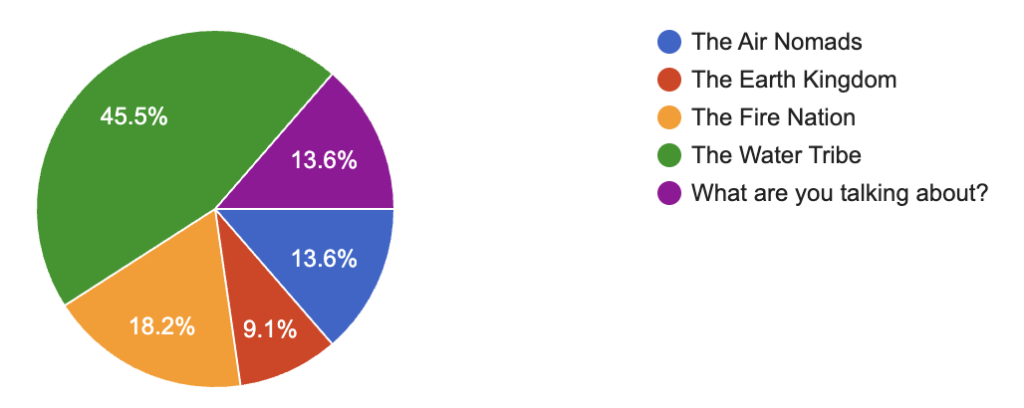
I do informal polling with all of my high school students. Just for kicks. I make up little questionnaires with questions like, “Which starter Pokémon would you choose?” or “Which brand of shoe is chopped?” and I give them to classes as an exit ticket. 75 or 100 students (usually) scan a QR code, which takes them to the poll question on Google Forms, and then I turn their answers into little pie charts or bar graphs and share the results with them at the top of each block.

There isn’t much academic benefit to this activity, but it usually spurs discussion and serves as a way of building up the class as a community. Also, it’s just fun. Very often, students will tell me what kind of poll information they’d like to know and I’ll put it out there for them.

Which of the “bender” kingdoms would you join?

Yesterday I discovered that over 33% of my students self-report as “Night Owls,” or people who feel most productive after midnight. (Most students reported they were most productive in the afternoon, which tracks with national averages, but “Night Owls” came in 2nd.)

It’s not surprising. You would not believe the number of students I see everyday who look absolutely drained. And not just during my first block — a lot of students are (understandably) tired at 7:40 AM (when my first class starts). But some of them are tired before lunch. Some are tired after lunch. Some are tired at 3:05 when they scramble for the exits and beat a hasty retreat back home.

You always hear stories about this in education. “Teenagers need more sleep,” or, “These kids play video games and doomscroll social media all night!”

It’s easy to say, “The kids are lazy,” and write it off, but it’s been my experience that those sorts of easy answers are either oversimplifications or are flat-out wrong.

In this case, probably both. Personally, I think younger people are more likely to be night owls just because they’re young. I was a night owl when I was a kid. As I’ve gotten into middle age, though, I’ve started waking up earlier and earlier, until, now, there are days when I wandomly wake up at 3:00 or 4:00.

The question becomes, “How do I help students who are chronically exhausted?” Sure, you can call parents and send home emails. Talk to admin or counselors to see if we can come up with a plan to help students stay awake, but I think a good first step is to, well, relax. Just chill out about the whole thing.

Calling kids lazy and punishing them for being too tired to participate can’t possibly be the best solution, especially if being a “Night Owl” is a natural part of cognitive development.

Other people probably know more about this; I’m years out of any psychological training. Do you think the desire (or drive) to stay up late is a thing that most teens experience?