A vice so nice I did it twice

Over the last few years, I’ve gone to great lengths to rid myself of vices. I’ve given up smoking, alcohol, soda, and coffee. I’ve started trying to eat healthier, to drink more water, and to exercise more.

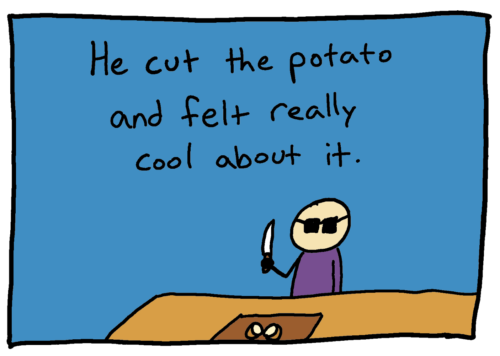
If I’m being honest, it’s been horrible. More than horrible. Boring.

When I lived and taught in Korea (between 2008 and 2019), drinking and smoking were practically required. It’s a pretty big cultural difference — I went out with coworkers much more frequently than you do in the U.S. People drank, smoked, and generally had a rip-roaring good time about once a week. It made you feel cool.

(In Korea I’ve been stumbling around drunk at 2 AM on a weeknight with the principal of the elementary school I worked at. There wasn’t anything strange about it. Everyone thought it was normal. Good even. In contrast, at my current school, we go out to dinner or something about once or twice each year.)

I feel decidedly uncool. In fact, I’m as square as a set of dice.

I’m pretty sure what I’m describing is called “growing up,” but it hasn’t been easy.

I’ve been trying to get myself to take pleasure in small things — the little daily rituals you do without thinking about it. Basically, I’ve been trying to think of myself as a character in a Haruki Murakami novel.

In case you’ve never read any of Murakami’s work, there are very frequently characters who embrace simplicity and routine as if it were their entire identity.

Tengo washed the rice, put it in the cooker, and turned on the switch. He used the time until the rice was ready to make miso soup with wakame seaweed and green onions, grill a sun-dried mackerel, take some tofu out of the refrigerator and flavor it with ginger, grate a chunk of daikon radish, and reheat some leftover boiled vegetables. To go with the rice, he set out some pickled turnip slices and a few pickled plums.

Besides being fantastic about food writing, you can see in this excerpt from 1Q84 that Murakami’s characters have a certain kind of presence (as in present in the moment) that I wish wish wish I possessed. I want to be the sort of person who can not only put together a healthy meal, but also enjoy the process.

I’m not there yet, but I’ve been trying for so long that I’ve started to wonder if it’s even possible.

Translations & Hand-Holding

The Epic of Gilgamesh isn’t what you’d call a “fun” book, unless you happen to be 4,000 years old or live in the ancient city of Nineveh. And let’s be real. The cost of living has gotten so bad that practically no one can afford that Nineveh rent.

What I tell people about Gilgamesh is that it’s (arguably) the oldest bit of literature humans have and that, on a sentence-by-sentence basis, the whole thing makes you question the very act of translation itself.

I’m normally a huge fan of parsing translated works. It’s an unusual stance, but I enjoy reading translations. They’re a linguistic playground — no translation is ever 100% accurate, so you get to ponder the smallest of details, question every turn of phrase. 

In Gilgamesh’s case, though, it isn’t just a language barrier. There’s also a time barrier that confounds the whole thing.

Example: There’s a part of the story in which Gilgamesh is going to bed in order to have some prophetic dreams while hanging out in the wilderness with his ol’ buddy Enkidu. After some dialogue, the author says…

“Then they took each other by the hand and lay down to sleep…”

As a contemporary reader, I can’t help but wonder, “Why are these two heroes holding hands?” We’re very nit-picky, we readers, and wonder about everything.

If it were a modern story (specifically one written in English), I wouldn’t need to wonder all that much about it. I understand why most modern English-speakers hold hands, and even if I didn’t I could figure it out from context. For Gilgamesh and Enkidu, though, it’s hard to tell. Did people 4000+ years ago hold hands the way we hold hands? Or was there something else to it?

As far as I see it from my desk here in the Teacher’s Plan Center, there are 8 reasons why it might happen, this ancient hand-holding. 

Reasons Why Gilgamesh and Enkidu Might Hold Hands:

  1. They’re pals. Pals hold hands, right?
  2. One of them feels nervous.
  3. They both feel nervous.
  4. They have a romantic relationship.
  5. It foreshadows a later event. 
  6. It’s a different form of nonverbal communication.
  7. It’s a ritual. (Maybe religious?)
  8. It signifies some kind of character development of which modern readers are unaware.

That’s not a comprehensive list — odds are the reason is either so simple as to be not worth mentioning or so ancient that we simply don’t know.

But that’s the fun of it. Or at least that’s how English Teachers get their fun — it’s just amazing to see something as mundane as holding hands turn into this timeless question of narrative detail.

If you want a real answer, though, you’re going to have to talk to someone smarter than I am. You silly people expect me to tell you everything?