There are a lot of things that happen in an educational setting today that didn’t happen when I was in high school. No surprise there — I’m a solidly middle-aged guy, so you’d expect that things would have changed in some way, shape, or form.
One change that has become an everyday buzzword in schools is a thing called “Bell Work.”
Practically, there’s nothing really new or groundbreaking about the idea of Bell Work; it’s just an activity or assignment that students are supposed to work on right as the bell is ringing at the start of class. The goal is to more efficiently utilize class time by having students do something immediately when they enter the room. (Because, presumably, students were doing nothing before.)
I’m guessing Bell Work became a thing because some administrator somewhere wanted to make it look like they were “improving” student and teacher performance at their school or district by shaving off those wasted minutes of class during which those same teachers and students were saying hello to each other and/or making small talk.
Anywho. There are a variety of bell work activities that I have students do throughout the year, but right now we’re doing a new kind of bell work that I’m calling “The Fight Bracket.”
Basically, I created a tournament bracket of 16 fictional characters that are going to square off in battle to discover who, ultimately, is the strongest fictional character of all. At the end of class, I give students a QR code to a Google Form that asks, “Who would win in a fight, X or Y?” and has the day’s two contestants as options. Whoever gets the most votes is crowned victorious and moves on to the next round.
The next day, I share the results and give out the next “Battle.”
ChatGPT made this. Sue me.
What does all of this have to do with English? Not a damned thing! It’s just entertaining to talk about.
No offense to the admin who thought up “Bell Work” as a way to show their boss that they were making schools better by cutting out all that “wasted class time,” but I’m going to spend a little bit of each day just doing fun stuff.
As Kurt Vonnegut said,
“I tell you, we are here on Earth to fart around, and don’t let anybody tell you different.”
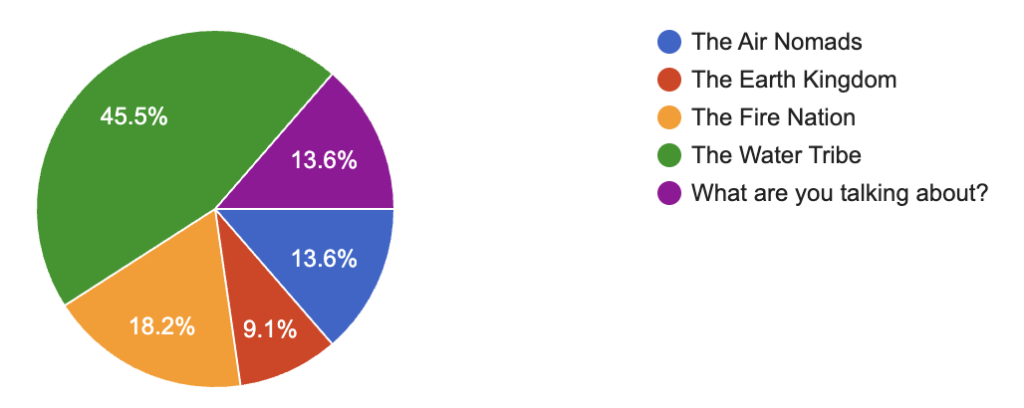
I do informal polling with all of my high school students. Just for kicks. I make up little questionnaires with questions like, “Which starter Pokémon would you choose?” or “Which brand of shoe is chopped?” and I give them to classes as an exit ticket. 75 or 100 students (usually) scan a QR code, which takes them to the poll question on Google Forms, and then I turn their answers into little pie charts or bar graphs and share the results with them at the top of each block.
There isn’t much academic benefit to this activity, but it usually spurs discussion and serves as a way of building up the class as a community. Also, it’s just fun. Very often, students will tell me what kind of poll information they’d like to know and I’ll put it out there for them.
Which of the “bender” kingdoms would you join?
Yesterday I discovered that over 33% of my students self-report as “Night Owls,” or people who feel most productive after midnight. (Most students reported they were most productive in the afternoon, which tracks with national averages, but “Night Owls” came in 2nd.)
It’s not surprising. You would not believe the number of students I see everyday who look absolutely drained. And not just during my first block — a lot of students are (understandably) tired at 7:40 AM (when my first class starts). But some of them are tired before lunch. Some are tired after lunch. Some are tired at 3:05 when they scramble for the exits and beat a hasty retreat back home.
You always hear stories about this in education. “Teenagers need more sleep,” or, “These kids play video games and doomscroll social media all night!”
It’s easy to say, “The kids are lazy,” and write it off, but it’s been my experience that those sorts of easy answers are either oversimplifications or are flat-out wrong.
In this case, probably both. Personally, I think younger people are more likely to be night owls just because they’re young. I was a night owl when I was a kid. As I’ve gotten into middle age, though, I’ve started waking up earlier and earlier, until, now, there are days when I wandomly wake up at 3:00 or 4:00.
The question becomes, “How do I help students who are chronically exhausted?” Sure, you can call parents and send home emails. Talk to admin or counselors to see if we can come up with a plan to help students stay awake, but I think a good first step is to, well, relax. Just chill out about the whole thing.
Calling kids lazy and punishing them for being too tired to participate can’t possibly be the best solution, especially if being a “Night Owl” is a natural part of cognitive development.
Other people probably know more about this; I’m years out of any psychological training. Do you think the desire (or drive) to stay up late is a thing that most teens experience?