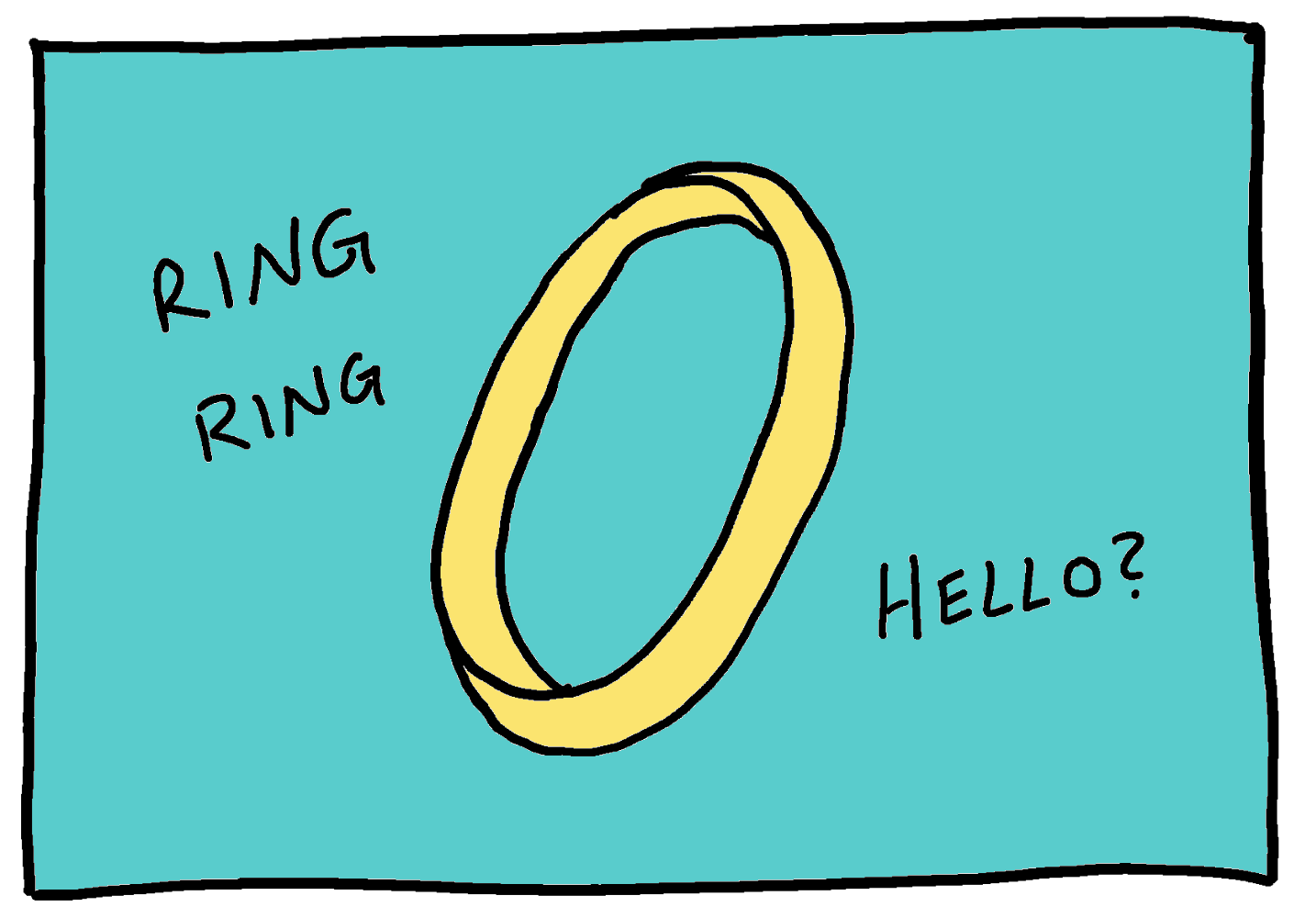
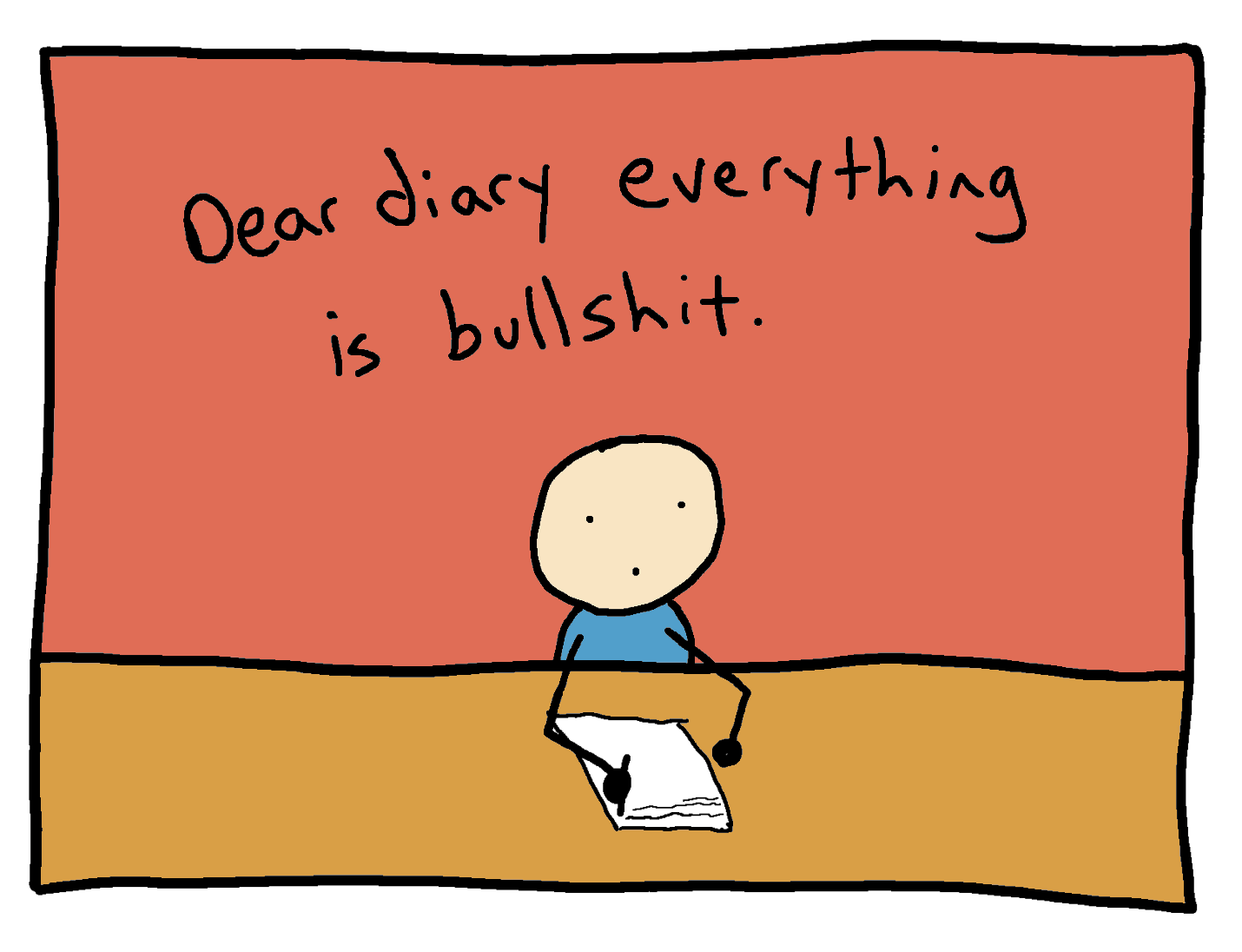
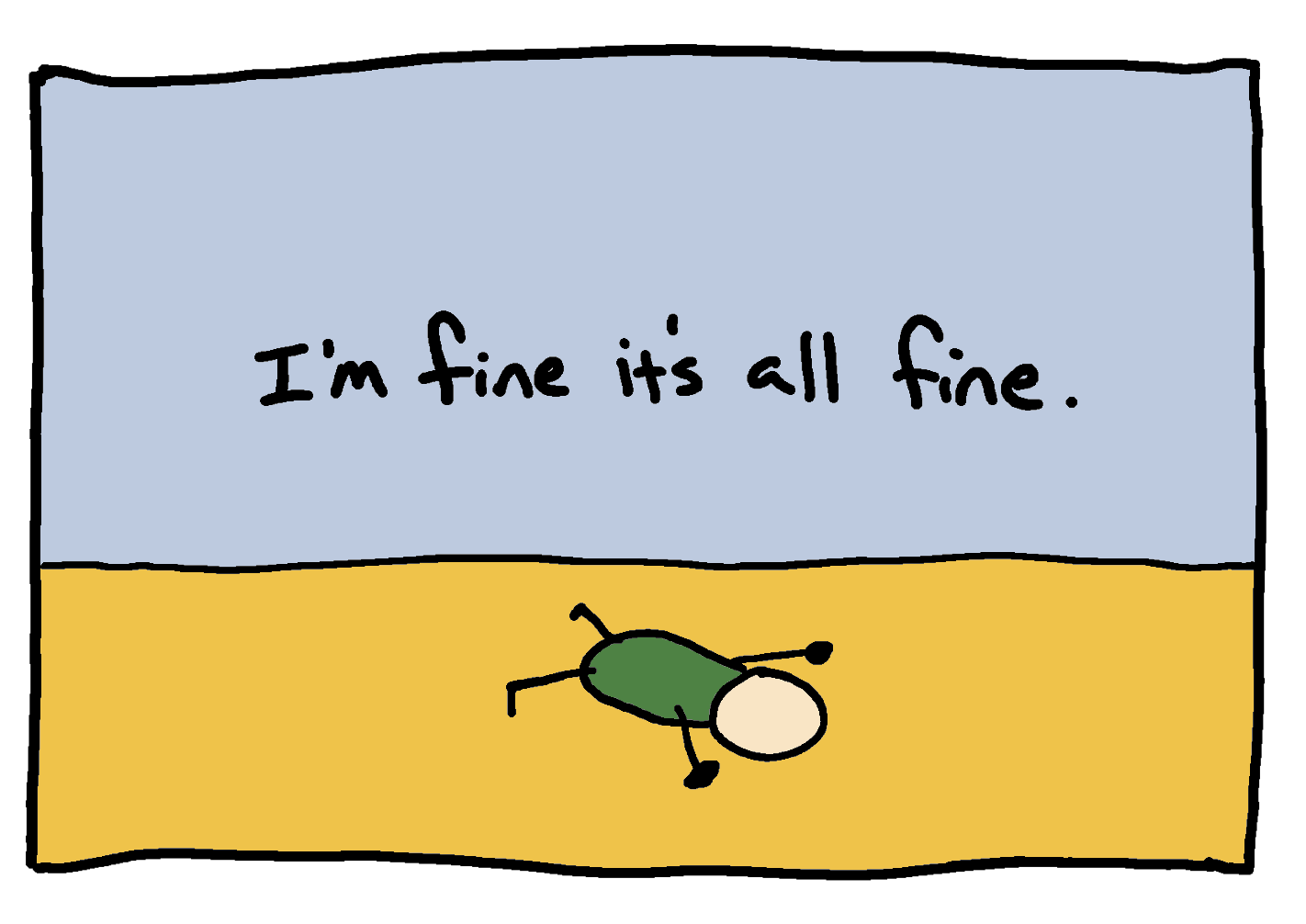
The thing to remember is that all you can really do is anything at all

I’ve had these moments for the past several days where my body will suddenly stop whatever it’s doing, as if put on pause, and an incredible and inescapable sense of ennui will wash over me like a layer of quick-dry cement. I’ll be just walking down the hallway with a cup of tea on my way to 2nd block when, WHAM, it hits. In this moment of intense hopelessness, my thoughts will turn incredibly dark and I’ll feel this sense of, “What’s the use of any of this? Why am I — why are WE doing any of this nonsense?”

It lasts for a fraction of a second; anybody watching would probably think I’d just had to do a sneaky, stutter-step fart or something, and then I’m back to normal, just walking along like everything is fine.

I don’t know why, but I feel a little guilty about it. Is that dumb? I think it is. It’s a stupid thing to feel guilty about and I’m aware of that, but I imagine what Dad is going through and can’t help but think he’s the one who is in the thick of it. I should focus on how to be helpful rather than dwelling on how bad I feel.

I talked to my brother about it quite a bit yesterday and I said something to the effect of, “I’m really starting to think that the only thing I can do — the only thing any of us can do — is to find happiness in little moments. Stop thinking about the past, stop thinking about the future, take a cue from all of those eastern philosophers and just live in the now.”

Trite? Maybe. Cliche? One-hundred percent. But it’s one way that I’m able to find some sort of comfort. Plus, in a new-agey, hippy sort of way, I really do think that Taoism has the right idea with entering a “flow state.” Spending too much time dwelling on the future is missing the point entirely.

Anywho, I was telling my brother this in the context of sharing this perhaps-too-on-the-nose clip from the movie A Beautiful Day in the Neighborhood:

(The part I’m talking about is at the end. “..to die is to be human, and anything human is mentionable. Anything mentionable is manageable. Anything mentionable is manageable.”)

I’ve also (surprise!) been thinking a lot about how uncomfortable most of us feel talking about death. I’ve been able to talk frankly about it with a few people in my life — Sarah, my brothers, a few friends — and it really does seem helpful.

Just keep moving, keep busy, keep talking. One foot in front of the other.

Like a lighthouse keeper with a broken bulb sitting on the rocks and weeping at the tide

Yesterday was ACT day at my school district and it was just…depressing.

It had snowed the night before (in April?!) and there was talk of a snow day, but we really only had about an inch, it wasn’t super icy, and all of it melted by early afternoon. Still, it was chilly and there was a bit of traffic. As we left the house, I felt bad for students who had to wait for a bus to come pick them up, which is (unfortunately) a lot of my students.

I was a proctor in the “Late Start” room, which meant I would be monitoring everybody who didn’t get to school by test time. My room would wait 2 hours and start normally so all the students who weren’t here on time would have a place to get their ACTs done. I was worried there’d be a bunch of late arrivals (more than last year) because of the weather, but there were only a handful.

On ACT day, only juniors come to school (because it somehow makes sense to give people an important test when they’re not yet finished learning English, Math, or Science). The juniors who were late that day weren’t just students whose cars wouldn’t start — they were the chronic absentees, students who are almost never on time. There are a lot of kids with this issue; Absenteeism is a big problem in American education.

It’s such a problem that I feel bad about speaking ill of these students. I know some of them and know that they don’t have easy lives, so disparaging them doesn’t feel all that cool.

Still. They are simply and frankly so dim-witted that I cannot fathom it. Literally. I cannot wrap my head around their lack of common sense or the complete absence of basic academic skills. I try to find reasons; I try to understand, to make sense of it. But, ultimately, I have no idea how or why they came to be this way. It has to be something systemic. A fundamental and (series of) major malfunction(s) in the way these children are raised and educated. Not just parents, not just teachers, not just friends — some combination of everything that can possibly go wrong going wrong.

I’ll just tell you about one student’s actions on ACT day so as not to over-pick all this low-hanging fruit.

One student, call him “Steve,” was having some trouble with the non-cognitive portion of the test. (That’s basically the part at the start of the test where you write down your name, address, and email. It’s not even really “part of the test.”) At the top of his question booklet, there was a spot for his “Name” and “Signature.”

As we read instructions, we made it explicitly clear that everyone had to write their name and add their signature. We announced it. We went around to tell everyone one-to-one that they needed to both write and sign their name.

“Steve” left this part of his question booklet blank.

As I was making my rounds, going desk to desk and helping each student in turn, I stopped by his desk and gently reminded him, “You write your name right here and then, right here, under that, add your signature.” Then I continued making my rounds to help the others. (“Steve” was, unfortunately, not alone in struggling to add his name and signature to a piece of paper.)

When I returned to “Steve”s desk, I was pleased to see that he’d written something.

Only…it wasn’t quite right.

The “Name” section he’d decided to keep blank. Where it said “Signature,” he’d written “STEVE” in big, elementary school block block lettering. That’s right–just his first name. He saw “Name” and “Signature” and thought to himself, “I can just write ‘Steve.’ Those ACT people will be able to sort it out.”

“Almost,” I said to him. “See here? You need to sign this. Do you have a signature?”

“Steve” didn’t respond.

“Just…uh, write your first name and last name here. And then, uh, write your name in cursive here.”

“Steve” didn’t respond. He almost never does. In my Creative Writing class, he’s one of the students who puts his head down and will not participate at all. I’ve tried to reach out to guardians, I’ve got admin involved, I’ve spoken to counselors. He doesn’t work, doesn’t respond, doesn’t seem to talk to anybody. I try to approach him with grace because…well, shit, what else is there?

At this point in our ACT journey, I figured it was a typical “lead a horse to water” scenario. If this kid doesn’t know what a signature is, then he’s got bigger problems than his ACT composite score. Besides, there was no time to teach him how to sign his name on test day. There were other students waiting, and the ACTs are very rigid on protocol — we have to start and stop at certain times, so we had to keep going.

“Just write your name twice,” I said.

“Steve” looked at his paper. Then he put his head down.

After that, I had to look up “Steve”s address because he didn’t know it. Same with his school email. While explaining that to him (“No, you need the ‘at’ symbol. It’s right there. No, there. This one.”), I had to explain how bubble tests work, because he’d apparently forgotten the PreACTs (and all the other Scantron tests he’s had to take over the years). Then I had to show him how to turn his answer booklet to page 3, which was beyond him. (“The pages are numbered — just like a book!”) In a lot of ways, it was like trying to get a cat to take a test.

The only difference was that cats don’t ask questions. Throughout the whole day, “Steve” had two things he wanted to ask about.

First (and this was before the test started) was, “When is lunch?”

The other question (that he asked 6 times over the course of 4 hours) was, “Can I go to the bathroom?”

As I write this, I feel like I’m not accurately showing you what the whole thing was like. It is so depressing that “blogging it up” with any sort of humor feels like I’m not treating it as seriously as I should.

It was like watching a car wreck.

No.

It was like sitting on the shore of a rocky beach somewhere, watching people struggle for breath beneath the crashing of tremendous waves, hearing their shouts, seeing their arms flail out beyond the breakers. I try to throw flotation devices their way, but they don’t know what a flotation device is, so they slap it away. The cry and wail and holler toward the shore, “Are we going to get some kind of snack at least? It seems unfair that we can’t eat!”

“Of course you can have a snack!” I shout back at them, “but could you focus on not drowning for a bit!?”

I’m met with a chorus of barely-audible gurgles that rise above the sound of the surf and all seem to moan, “I need to go to the bathroom!”

(Yes, I know the kid who went to the bathroom 6 times was probably vaping in there. But guess what? I am not the goddamned bathroom police. I refuse to be. Short of following him in there and standing right outside his stall, there’s not much I can do to curb that kind of shitty behavior. Plus, you never know. Maybe he had the rumble tums and legitimately needed to poo.)

If there is one thing that matters in this life it is how you throw your sticks

I asked Dad to bring the ring I would use to propose when he came to visit, which was the first time I ever hinted to anybody that I was going to ask Sarah to marry me. It wasn’t the entire reason dad came to visit me in a different country, but it probably helped.

I don’t know if my parents…approved of my living in South Korea for as long as I did. Mom certainly thought of South Korea as a place that wasn’t even worth visiting, but after she died my Dad came to see me for about a week, bringing the ring along with him, and booking a hotel near where Sarah and I were living.

It was during a rough time. For all of us. I was coping with my mom’s passing by turning from a heavy drinker into an incredibly heavy drinker, and my dad’s plotted course was along much the same vector. South Korea was perfect for us in that regard — their drinking culture is tremendous and vibrant. It’s easy to drink and be drunk at any time of day, and they don’t care if you do it in public. They encourage it. It’s a source of national pride.

I think Mom never approved of South Korea simply because I’d moved there and she couldn’t abide any country (or city or person or philosophy) that “took her boy away.” Mostly, though, South Korea wasn’t what she considered to be an “easy” country to travel in. It wasn’t a place for packaged trips or guided tours, which was how she preferred to travel.

Dad, though, figured at least one of them should visit me. I’d been living there for over 10 years at that point, and after Mom died, Dad bought tickets.

One of my strongest memories of when dad came to visit — besides the wicked hangovers — is of drinking martinis and playing Yut Nori at a hotel bar in Yulyang-dong.

He stayed at one of the fanciest hotels in town at that time (which wasn’t saying all that much). It was right above Homeplus and had a pretty decent bar on their top floor. My father had this thing he would do where he’d ask a waiter if they knew how to make a martini (they usually didn’t — martinis aren’t as common in Asia) and then would get all in a huff when they made it wrong. “Well I suppose I’ll have to speak with the bartender.” I guess he thought he was doing the world a favor by ensuring every barman he met across six continents knew how to make a decent gin martini.

Anywho, we got pretty toasted one night and were playing this traditional Korean game called “Yut Nori,” or just “Yut,” which is sort of like the board game Sorry! only instead of rolling dice you throw four sticks to see how far you move your piece across the board.

The fact that we were playing in a fancy hotel bar was unusual — Yut Nori, in my experience, is usually played by old gamblers in public parks or by families on particular Korean holidays. Playing it where we were, in a fancy hotel bar, was kind of like playing hopscotch at The Plaza. The bar was empty, however, and I explained to the servers that I was just trying to teach my dad how Yut Nori was played. (It was a cultural exchange more than anything else. Certainly not just my dad and I getting plastered and throwing sticks across a bar…)

Part of the way into the night, I realized my dad was cheating at Yut Nori. The trick was in the way he threw the sticks. Instead of tossing them, as was protocol, he would sort of roll them across the carpet of this fancy hotel bar in such a way that they would all land flat side down.

“You can’t do that,” I said. “If you roll them like that, it makes it more likely that they’ll land flat side down. It’s cheating.”

“It isn’t cheating. Look. I’m tossing them just like you said.”

Instead of tossing them, he once again rolled them. All four sticks landed flat side down. To this day, I don’t know if my dad was trolling me or if he really didn’t understand how the sticks were supposed to be thrown. Either way, he wouldn’t listen to reason, and did not seem to understand no matter how much I explained.

So, I called the waiter over. There were no other patrons at that hour, so it wasn’t like he was busy or anything, and I asked him if the way my dad threw the Yut was legal.

“Legal?” he said.

“Allowed,” I said.

“Oh, yes, yes,” he said, smiling at my father. “That is allowed. The way he throws. Very much allowed.”

After the waiter left, Dad said, “See? Perfectly fine throws. Perfectly fine. Very much allowed.”

I said, “The waiter is only saying that because you’re older than he is and it’s customary not to go against your elders. If you weren’t such an old bastard, he would have told you the truth.”

“You’re just bitter that I’m winning.”

“Oh, am I? Fine. I’ll start throwing the bones the way you do. Then we’ll just see who wins. We’ll just see.

So, I, too, started rolling the Yut. They continually landed flat side down, all four sticks. It was like playing an American board game and only rolling sixes with the dice. All game. On every throw.

“See how dumb this is?” I said.

“It’s not my fault they don’t have good games in South Korea,” Dad said, tipping back the rest of his martini and, no doubt, wondering how best to explain to the Korean-speaking bartender that vermouth ought to be sprayed on the ice rather than poured.

We didn’t talk much about Mom that trip. There was only the part where Dad gave me the ring that Mom had made before she died, which was a simple, modest golden band in a red box. The most remarkable thing about that ring (besides the person who now wears it) is that it’s made of the melted and reforged gold from the wedding rings of my mother’s mother and grandmothers.

I carried that ring in my backpack for months before I used it, and when I did, absolutely nothing went according to plan.

Blogging about diseases is boring and sad but I need to remember these things so here we are

I haven’t been reading much. Well, I’m still reading a little, but I’m so preoccupied that in my off time I just veg out and either watch YouTube or TikTok. Still, I’ve gotten through Dungeon Crawler Carl and am currently working through the second book in the series, Carl’s Doomsday Scenario. I’m doing the print version and the audiobook (which is interestingly done).

The series is fine. I like the relative mindlessness of it. Blowing up goblins and punching monsters so hard they explode. There are some unique aspects to the plot structure that are worth examining on a serious level — I feel like the arc of the story is built to be understood from a macroscopic lens; characters will make more sense the more books you get into the story. It’s as if the author planned on writing hundreds of thousands of words and just thought, “We’ll get to it eventually.”

As a writer, I’m used to doing this stuff quickly — I’m borderline minimalist. “Get to it!” that’s my motto. Or, as Vonnegut puts it, “Start as close to the end as possible.” Don’t waste words; your readers’ time is valuable and you should use it well. Reading Carl reminds me how flexible these rules are, because there’s a lot of stuff I don’t get or simply wouldn’t do.

It’s unfathomable to me that we don’t have more information about Carl’s ex-girlfriend yet, even though you know she’s going to make an appearance (or be brought back up somehow.)

I’m also not a fan of giving readers actual numbers for strength and intelligence. This book will give each character a level and stats, all of which are explicitly told to readers. Is this why they’re calling it “LitRPG?” (Horrible, horrible name IMO. And maybe, overall, just a bad idea.)

Increases in ability should be shown through action not spreadsheets. The spreadsheets were only ever created for RPGs like D&D where you couldn’t easily show strength or intelligence through action. In a narrative, though, all we have is time to show how characters act. That’s the whole point of a story.

I will never read a sentence like, “My strength was at 30 so I was confident I could win the fight,” and think, “That’s some good writing!”

I know, I know, not everything needs to be literary. Besides my gripes at the LitRPG genre in general, Dungeon Crawler Carl has been fun so far.

Anywho.

My dad has a feeding tube installed in his stomach and is out of the hospital, but his condition doesn’t seem to be…improving, or at least not improving rapidly. While he’s glad to be home, he really doesn’t have a lot of energy. I don’t know if that’s from the cancer or if it’s from weeks of not being able to swallow due to the tumor in his esophagus (which is growing rapidly), but it isn’t a good sign.

Sarah, my brother, and I went down to visit yesterday. Dad was able to get up and move around, but not much. He can’t swallow anything at all and chews on ice like they have you do in the hospital. His headaches are getting bad. He has a big red bottle of hydrocodone you can inject in his feeding tube.

Radiation treatments start this Thursday and will continue for most of April. Chemo will start after that, depending on how the radiation goes.

A “home run” at this point isn’t a cure; a home run is shrinking the tumor in dad’s throat enough that he can swallow food. Not only will that make his quality of life much better, but being able to get more nutrition will be an added bonus. Dad loves eating and I hate thought of him missing out on food he enjoys in favor of the flavorless goop that goes right into his belly.

Time marches forward.

School continues. The ACTs are tomorrow and I get to proctor.

Sarcastic yay.

I need that green drink fix man I’ll do anything

When I was 28 or 29 and living in South Korea, there was this little old saleswoman who would come into our private school and sell little, tiny bottles of fresh juice. She was small and polite and wore an apron as if she’d just come from the factory where they squeezed the greens. She drove around the neighborhood on a little refrigerator cart bringing juice to local businesses. (It is a job I’ve often dreamed of having…)

This little, old saleswoman said something like, “For $0.60 a day, you too can feel the health effects of mashed undergrowth!” and passed out a few free samples. Her schtick was you’d sign up with her and then, once a day, she’d come in with her electric cart and bring you a healthy little drink or two. There was pomegranate, garlic, ginger. All sorts of plants that you don’t normally associate with being “juice.”

The free sample I got tasted like grass that had been cut with the sharpened edge of kale leaf. It was bad, but not in a disgusting way. Bad like the most intense salad flavor you’ve ever tried. It was the most “green” you could possibly cram into such a tiny bottle.

I was immediately hooked. I’m not a masochist (I think) and I’ve never really loved salads, but at that point in my life I was very much in a Try-Everything-There-Is! sort of mentality. It’s just sort of something you need to do while you’re traveling — be open to ideas, try things you wouldn’t normally try, go places you wouldn’t normally go. It’s the attitude that lets you try eating dog, scorpion, or silk worm larvae. “Get uncomfortable,” basically. So, I signed up to have the lady bring me the grass/kale drink three times a week.

Since then, I’ve made a habit of drinking strange “green drink!” just about everywhere I go. I’ve been doing this for years, but over the last 1 or 2, I’ve made it a daily habit.

Recently, I found this at my local grocery store:

And holy shit! My first sip was so intensely green that I thought I’d poisoned myself.

Sarah and I tried it together yesterday morning, pouring a small amount into a couple of glasses and downing them in one shot like it was Everclear.

“Gah,” I groaned, temporarily unable to form words.

“Is it supposed to burn?” Sarah asked, near tears.

“I think…that’s the…ginger,” I gasped. “It’s…fresh.” Then, as I usually do, I shouted, “Green drink!” because you have to shout that when you’re recovering from the health effects of these drinks (effects like hot neck and fizzy tum).

Anywho, I didn’t really poison myself. That drink is just…intense. They need to start doing commercials for it like they did for 5 Gum, except in these commercials people will say, “This is what it’s like to drink Suja!” all while being intensely and graphically violated by greens.

It might not sell very well at first, but I believe the commercials will find the right people. The people who need to see such things. Most of them probably aren’t even aware that they need to.

Thanks I hope so too

My dad is sick and I am a mess.

He was diagnosed with esophageal cancer a few weeks ago after a hurried trip to the ER when he started having difficulty swallowing. Scans revealed a tumor in his esophagus that prevented food from going down; more scans revealed that the cancer had spread. The prognosis is bad. Stage 4, likely inoperable.

I hate hate hate talking about it. Thinking about it is hard enough — I try to dumb myself down with substances in my off time specifically so I don’t have to dwell on it. Is this healthy? Not one bit. But I’m doing what I can to get through the day. Or, at least, that’s what I tell myself.

I’m at a point where I’ve started letting people at work know about what’s going on. Students are asking me about it; I missed school yesterday so I could go sit with dad while he waits to get a feeding tube put in, and today, first thing, I was met by a bunch of, “Where were you yesterday, teach?” (Students don’t really call me “teach,” but I’m hesitant to put my real name on here. I’d hate for my solitary reader to know who I am.)

This is what I assume you look like.

I don’t lie to students about stuff like this. It might be easier if I did, but this sort of thing is a part of life and there’s no use hiding from it. Plus, it isn’t as if people won’t notice something bad is happening. I probably look awful. Still, I won’t go advertising it because, again, I hate hate hate discussing it. When I have to talk about it, I try to sound as positive as I can to keep classes from turning into some kind of morose pity party.

So I smile and say, “Oh, my dad’s in the hospital and I wanted to drive down to be with him.” The conversation continues for a bit and, invariably, students say to me something like, “I hope your dad gets better soon!”

As much as I want to be truthful, I can’t exactly tell them that this isn’t the sort of cancer that gets cured. I pretend to be positive and, while it’s not technically the truth, I just tell students, “Thanks. I hope so, too!” in the most upbeat tone I can muster. It’s better than saying, “I don’t feel hope anymore,” which (unfortunately) is where my head is currently at.

Putting on this act is exhausting and It. Never. Stops. It’s so tiring that there are days when I don’t know if I can actually handle it. My body, like a house consumed by flames, will crumble in on itself in a pile of ash and smoke. “That was a nice old building,” couples will say as the amble by.

How do people do this? I have come remarkably close to losing it this week, and it’s only exacerbated by knowing that worse things are yet to come. Every time my phone rings or I get a text notification I immediately think, “This is it.” A memory will randomly make me feel like crying. I have to excuse myself from class every now and then just to get a moment alone to breathe.

Snowless snow

“There’s no way we’ll have a snow day tomorrow,” I believe were my exact words to students yesterday.

We have the day off.

I knew there was snow in the forecast, but it looked like a small amount and our district is notoriously stingy with “snow days” to begin with, so I figured there was a snowstorm’s chance in hell that we’d actually have a snow day.

While I’m not going to complain — it’s always nice to have a break in the middle of the week — I am confused by the decision. It’s noon now and it hasn’t yet snowed a single flake. It’s cold and it’s gray and it’s windy, but “cold, gray, and windy” describes Nebraska 50% of the year.

I’ve started reading a book called “The Atrocity Archives” by Charles Stross. It’s the first book in a series called “The Laundry Files,” which seems to be about a British IT guy who’s employed by a government agency (“The Laundry”) that fights against extra-dimensional Lovecraftian horrors.

Sounds like a hoot!

I picked up “The Atrocity Archives” because I was hankering a little Brian Lumley, who used to write books with covers like this before he died a few years ago:

“Necroscope” is a series about a guy who can talk to dead people and fights against an intense body-horrorish breed of vampire (Wamphyri!) from an alternate universe. There are about 16 books in the Necroscope series, and I was really into them when I was in college.

The Laundry Files should scratch that particular itch, but I know very little about these books. (Which is pretty fun, actually. I feel like I usually know a lot about books I read before I read them, which helps me appreciate the writing but leaves little room for surprises.) I’m excited to see what The Laundry Files is all about.

Perfect fodder for a snowless snow day.

A vice so nice I did it twice

Over the last few years, I’ve gone to great lengths to rid myself of vices. I’ve given up smoking, alcohol, soda, and coffee. I’ve started trying to eat healthier, to drink more water, and to exercise more.

If I’m being honest, it’s been horrible. More than horrible. Boring.

When I lived and taught in Korea (between 2008 and 2019), drinking and smoking were practically required. It’s a pretty big cultural difference — I went out with coworkers much more frequently than you do in the U.S. People drank, smoked, and generally had a rip-roaring good time about once a week. It made you feel cool.

(In Korea I’ve been stumbling around drunk at 2 AM on a weeknight with the principal of the elementary school I worked at. There wasn’t anything strange about it. Everyone thought it was normal. Good even. In contrast, at my current school, we go out to dinner or something about once or twice each year.)

I feel decidedly uncool. In fact, I’m as square as a set of dice.

I’m pretty sure what I’m describing is called “growing up,” but it hasn’t been easy.

I’ve been trying to get myself to take pleasure in small things — the little daily rituals you do without thinking about it. Basically, I’ve been trying to think of myself as a character in a Haruki Murakami novel.

In case you’ve never read any of Murakami’s work, there are very frequently characters who embrace simplicity and routine as if it were their entire identity.

Tengo washed the rice, put it in the cooker, and turned on the switch. He used the time until the rice was ready to make miso soup with wakame seaweed and green onions, grill a sun-dried mackerel, take some tofu out of the refrigerator and flavor it with ginger, grate a chunk of daikon radish, and reheat some leftover boiled vegetables. To go with the rice, he set out some pickled turnip slices and a few pickled plums.

Besides being fantastic about food writing, you can see in this excerpt from 1Q84 that Murakami’s characters have a certain kind of presence (as in present in the moment) that I wish wish wish I possessed. I want to be the sort of person who can not only put together a healthy meal, but also enjoy the process.

I’m not there yet, but I’ve been trying for so long that I’ve started to wonder if it’s even possible.

Ultimately nothing did happen

This blog wasn’t exactly a new year’s resolution; it just so happened that I started blogging again at the beginning of a new year and was somewhat resolved to blog every day. Like any pedestrian chump, though, I fell off after about a month.

Sad!

The trick is, I’ve learned, not to beat yourself up over resolutions that you make. Buddhists always say “Everyone suffers,” but if I could add a western spin to that idea, I’d say, “Everyone fails.”

It’s just true. No matter what you do, how often you do it, how good you are at it, or whether or not that thing is your passion, you will have setbacks and you will eventually face failure.

Imagine two people who make a resolution to go jogging every morning. Both people, being regular people, will eventually fail at this resolution in some wayshaperform. It just happens — they have a sick day or they forget to set an alarm or the ground is covered in ice — the world conspires against them and they can’t jog.

Womp womp! But how do they react to this failure; that’s the question.

Person A says to themselves, “My perfect record is tainted! I’d planned to run every day, but now that I’ve failed, what’s the use? Everything is horrible and life is a crap chute!” So they stay home and feel bad about their failure because it wasn’t perfect.

Person B says, “Oh, I couldn’t jog yesterday. Whoops!” and then goes jogging anyway.

I have, unfortunately, always put myself in the former category. I wish I wasn’t there, but here we are. I beat myself up for failing at goals that I have set for myself and I’m not sure what to do about it.

Other than to keep plugging away at this blog as if nothing happened. Because, ultimately, nothing did happen.

That was my plan all along

The school where I work has what’s called a plan center, which is slightly different that a teacher’s lounge (in that it’s not meant for “lounging”). We have this plan center because my school has more teachers than it has classrooms. The school simply isn’t big enough for each teacher to have their own room; we’re packed in like sardines, teachers and students alike.

It’s incredibly annoying. If I want to, say, grade papers during my plan time, which is a daily thing, I have to carry the papers from my files in a classroom (where, you know, the students are) down the hall to the plan center and carry them back when I’m done. It gets even trickier when I have to bring any sort of supplies, like colors or rulers or construction paper, from one place to the other. (A lot of our teachers use little wheelie-carts to haul these supplies around.)

Another annoying aspect of having to use a plan center is that the plan center can get a little noisy.

It’s usually just teacher chit-chat, but it’s bothersome at 7:30 in the morning when I’m trying to get lesson ready for the day.

This morning, a bunch of teachers were talking about negotiations between the teacher’s union and our school district. Apparently, our union is pushing for smaller class sizes, which is something of which we are in dire need. (My biggest class has 36 students, which is incredibly difficult to manage.)

The district, in its infinite wisdom and remembering that education is a top priority for 90% of voters in this country, is pushing for pay cuts and maintaining that a student/teacher ratio of 36/1 is just fine.

Who, in good conscience, can possibly argue for bigger classes and less pay? I cannot fathom these fucking clowns. You could pack them into a car.

It makes me want to say thanks for the support, guys! I can really see why American schools are considered “the best in the world.”