Feeling Fancy & Not Hooked

“A Court of Thorns and Roses” is coming along nicely. We had a three-day weekend, so I was able to read a bit more than usual, although a lot of time was taken up by Diablo IV. (One more character to go and I’ll have each class running Torment IV!)

I’m hoping that “Thorns and Roses” has some surprises in store, because I’m honestly reading through it thinking to myself, “Yeah, yeah, I get it. Move the plot along,” which is what I find myself saying more and more when I read modern fantasy. It’s not bad by any stretch, but I don’t think it’s hooked me yet.

I’ve been missing Korea a lot recently. I used to be an expat, living in South Korea and other parts of Asia between 2008 and 2020. The pandemic kind of forced my wife and I to move back stateside, but I secretly (or maybe not-so-) wish we were living somewhere, anywhere other than the United States.

(To all those red-hat freaks who like to yell, “If you don’t like it here, then get out,” I would love to. You should get out too, if only to see that other countries are doing it way better than we are.)

There are oodles of practical reasons why living outside this country sounds appealing. Other countries have better infrastructure, better healthcare, better cost of living, better environment, nicer people, better public transportation, better education, and aren’t being run by rapist grifters who are perpetually apologised for by nearly every U.S. new source. (Seriously, at what point do news stations say, “Maybe it isn’t okay for us to report this brain-addled octogenarian’s plan to invade Greenland as if it’s anything other than the ramblings of a troll and a moron?”)

What’s got me feeling “homesick” for a foreign country today isn’t anything so grandiose. I just happened to find a brand of hand soap that’s scent reminds me of a hotel I used to stay at in Seoul.

Scent is a powerful reminder, and when I washed my hands this morning in lavender and bergamot, whoosh, I was brought right back to the J.W. Marriott above the Express Bus Terminal in Seoul. I didn’t stay there a lot, but any time I wanted to feel fancy in Korea, that was where I stayed.

And now the scent of their hotel soap makes me feel fancy.

Sigh. What a world.

My only wish to catch a fish so juicy sweeeet

Making lesson plans stresses me out. It always has and I see no reason to assume that it will stop — everyone says you need to spend 5 years at a teaching position before you’re “comfortable” there, so I figure I’ve got years of stress left. And, while I consider this kind of stress to be a “Good Stress” (a B.S. term for stress that produces better results from us working-class drones), I do think it is sometimes detrimental to my health.

It doesn’t help matters that I’m a perfectionist when it comes to planning. “Perfectionist” might not be the right word. I’m a planaheadionist. A person who believes that being well-prepared is one of the best things you can do to improve your classes.

In any classroom, there are a million things you can’t control. You can’t control whether or not Timothy is going to refuse to participate. You can’t control if or when Susan will throw a pencil at Timothy because he keeps whispering at her. You can’t control if you’ll get diarrhoea and you certainly can’t control whether or not 90% of your students haven’t ever heard of Mark Twain.

One of the only things you can control is how well you’ve planned that day’s lesson. Depending on all the other factors, your preparation can make or break the whole day. It’s not a silver bullet, but it is a bullet, and bullets are strong. Wait, what? (Maybe bullet metaphors might not be the best metaphors to fire off in this situation.)

Anywho. If I find myself ill-prepared, I get so anxious about it I’ll make myself physically sick. Not even joking — during my first 1-2 years of teaching at a public school, I’d call in for mental health reasons once or twice a semester. I used to feel guilty about it, but now I think fuck that. I’m going to take as many sick days as I see fit.

It does explain why I get so manic sometimes. I’ve known so many great teachers in my life that doing anything less than my best at this job makes feel like I’m letting everyone down.

That’s why you’ll find me so frequently on a school night mumbling over Amazon.com like some suburban Gollum whispering, “Why shouldn’t I have a PRINTER all my own. Yes, yes! A Brother printer for my desk and maybe one more for my classroom…!”

Not to make myself sound like God’s gift to anything. While I know that preparedness is a key to success, all that amounts to most days is I’m painfully aware of how ill-prepared I am.

And that stresses me right out.

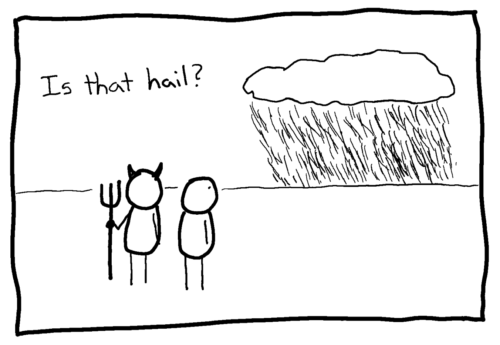
El Granizo de Satán!

I’ve been playing a lot more Diablo IV this season. I wouldn’t say I’ve been no-lifing it, but I have been playing just about as much as is possible for a DINK (Dual Income, No Kids), which is nothing to sneeze at.

I’ve dabbled in Diablo every season since Diablo III came out in 2012. I’ve never been great at it, but I’ve pushed a lot further into the seasonal objectives this time around. As a matter of fact, Sarah and I just beat Uber-Lilith last night, which was the last objective I needed!

I know that doesn’t sound like much of an accomplishment, but it puts a smile on my face.

A big part of the reason I’ve been playing Diablo as much as I have (besides having two weeks off for the holidays) is because Sarah plays the game with me. There’s a decent couch co-op mode for Diablo on PS5, so Sarah and I spend a lot of weekday nights hanging out “dabblin'”.

I don’t have a lot of advice that I normally give out to people who are thinking about getting married, but one thing I’d tell them is this: Marry someone who likes the same pointless crap as you.

A BLANK of BLANK and BLANK

Upon finishing “GIlgamesh,” I’ve moved on to, “A Court of Thorns and Roses” by Sarah J. Maas. (Is that the right number of “A”s? Or are there three? Maaas? Maaaas?)

I don’t know why I downloaded it. I don’t know why I’m reading it. Why does anybody do anything?

That isn’t me being saturnine — I’m just saying that I need to be more open in my criteria for selecting what I read. I feel like I turn my nose up at too many books.

In 2008 or 2009, back when I was living in Korea, some friends and I went to see the first “Twilight” movie on accident. We had no idea what it was about (other than there were vampires in it — “So it’s probably a scary movie, right?”), and my friends didn’t exactly “warm up” to the subject matter. Some of them were even afraid to show their faces in daylight after that experience.

I was right there with them, until I happened to pick up the book version of “Twilight” at the bus station one night. I bought it while I was waiting for a bus from Seoul to Cheong-ju, which wasn’t a bad ride if you had a book, and I was desperate. (It wasn’t easy to get English books in Korea back then — you had to read what was available, and “Twilight” was available.)

The book hooked me immediately. Again, I don’t really know why. And it’s easy to poke fun at that series. The mindlessness of it? The heavy-handedness? The jarringly bad dialogue? Something about them kept me coming back, though, time after time, book after book. I turned down offers to go do actual things in favor of staying home and reading “Twilight.” I loaned the book to people and said, “I know it’s controversial, but I’m on team Jacob!”

(I wasn’t, though. I just like to get a rise out of people. #stillteamedward)

Sure, I was probably just being ironic and the worst kind of hipster, but my point is that I got a kick out of those books and still do. And, if I hadn’t accidentally stumbled into what I thought was a horror movie, I would have never even heard of them.

I don’t mean to equate “Twilight” and “A Court of Thorns and Roses,” but I guess that’s exactly what I’m doing.

Anywho. Since “Twilight,” I’ve been a little less hesitant to read the mass-published powerhouses of Y.A. and Fantasy, even though they all have names like, “A BLANK of BLANK and BLANK,” and, I’m pretty sure, are just thinly-veiled excuses for librarians to read pornography.

So, I’ll give Sarah J. “Mucho” Maas a try. What harm can it do? (“Harm? Harm, Bella? All I can do is harm you. This is the skin of a monster! A twinkling monster!” *swoon*)

Quiet Cats & Whispering Cooks

I’m teaching my cat how to whisper.

I don’t know a lot about training cats (I seem to recall something about outrageous facial hair and a guitar case full of feathered toys), but what I do remember is that positive reinforcement works the best.

My cat’s name is Jolene and she is blind as a bat. She’s a bengal, and besides being blind, she also loves being around people and is extremely vocal. If you’re in the bathroom, she wants in the bathroom. If you’re in the garage, she wants in the garage. If you’re sitting on the couch, she wants to be sitting on you on the couch. If she’s unable to do any of these things, she’ll meow at you until she can.

She’s a great cat and I love her to death, but she can be annoying. Especially when we’re trying to cook.

Jolene loves all the smells and the sounds of the kitchen — but she also realizes that the kitchen is a dangerous place full of fire and strange liquids that might splash in your face. Since she can’t see anything, whenever we’re cooking, she’s torn between her desire to get in there and see what’s going on and her fear of burning her lil whiskies.

She’s struck a balance by standing on a nearby empty counter and meowing incessantly at whoever happens to be slicing or dicing or what-have-you.

So, what I started doing was giving her a lot of attention. Positive attention. Whenever I was cooking and Jolene jumped up on the counter, I’d go over and pet her the way she likes, scratch her head, get her purring, and then I’d lean in real close to her ear and whisper, “meow,” in the tiniest voice I could muster.

It took a couple of weeks, but Jolene finally caught on. “Oh, I get it,” she thought. “We’re being sneaky!”

She might not have understood why we were being quiet, but pretty soon I’d lean in and whisper, “meow,” and she’d rub her nose against me and meep out the quiettest little, “meep,” right back at me. It’s become a bit of a routine.

On the nights when I cook dinner, I make sure to go over to the counter and pet the kitty and give her a little whispery meep. Putting ice in a glass? Meep. Unpacking groceries? Meep.

She hasn’t really taken this habit to the rest of the house, but now, when I’m flipping eggs or whatever, there’ll be a surprising little whisper from nearby, and that means it’s time to take a minute to go pet the cat.

“Who is training who,” you whisper with a smile.

I whisper back, “Whom.”

Failing & Meetings About Failing

It’s early in the spring semester at the high school where I teach, which means it’s time to have meetings about failing students.

What a treat!

This year’s crop of Juniors (to whom I teach English) are securely buckled into the struggle bus with their “on track” numbers (the number of students in the class who are on track to graduate next year) falling wayyyy behind other classes. Something like 1/3 of the students are missing required credits.

It’s not that they won’t graduate. It’s that they’re behind.

This isn’t the school’s fault, it isn’t admin’s fault, and it surely isn’t the fault of the parents or the students or the teachers. These are students who went through all the remote-learning pandemic nonsense right when “socialization” was most necessary — in elementary and middle school. It should come as absolutely no surprise that they are struggling; their view of education has been wrecked by years of shake-ups and the whole crap chute of “remote learning.”

The biggest educational detriment provided by the pandemic was, in my opinion, convincing millions of students that they just didn’t need to be at school. They went through years of remote learning, which is wildly ineffective, but they still passed all their classes. Now it seems like many of them (and their families) are questioning the whole institution of public education.

Fair enough. Question away! I say. But you can’t be surprised that over 1/3 of the class isn’t on track to graduate. And we certainly shouldn’t be having meetings where we point fingers and assign blame. “How do we best support students who aren’t showing up?” is a question that most classroom teachers aren’t equipped to answer, and the solutions are probably things that most classroom teachers can’t implement.

It’s not like we can sneak into Billy’s house and set his alarm for him.

When I look at a list of students who are failing my English classes, the unifying factor between them is they simply aren’t coming to school. And, on the odd day when they do show up, they don’t get enough work completed to receive a passing grade.

Example: Last semester, I had a student submit a total of 2 assignments. 2 assignments out of 25. And she still expected to pass! It came as a shock to her that she didn’t.

“I got a good grade on the final. I thought that would be enough!”

The student definitely could have passed — she’s got tremendous writing skills, speaks well, and I’m sure would be able to analyze a literary text — but she didn’t show any of that in her work. Why? She was only here for a handful of days.

That student isn’t alone. It’s happening a lot with the students in my classes, and it’s happening all over the country. In 2019, pre-pandemic, about 15% of students missed at least 10% of class days. After the pandemic hit, that number doubled, rising to around 30%. It’s been going down, but 23-25% is what’s being projected now (in the ’25-’26 school year).

(It’s normally the Department of Education’s job to keep track of these statistics, so it’s a good thing our nincompoop-in-chief shut the whole department down via executive order. Who wants to help kids stay in school, anyway? Certainly not republicans.)

Is that an over-simplification? Sure it is! There are other obstacles standing in students’ way — hello, cell phones! — but this problem, “Chronic Absenteeism,” is the first thing my school needs to tackle if we want our students to walk across that stage next year.

And, quite honestly, I have no idea what to do about it. Decisions are made by people who show up, but what decisions do you make about the people who are staying home?

Translations & Hand-Holding

The Epic of Gilgamesh isn’t what you’d call a “fun” book, unless you happen to be 4,000 years old or live in the ancient city of Nineveh. And let’s be real. The cost of living has gotten so bad that practically no one can afford that Nineveh rent.

What I tell people about Gilgamesh is that it’s (arguably) the oldest bit of literature humans have and that, on a sentence-by-sentence basis, the whole thing makes you question the very act of translation itself.

I’m normally a huge fan of parsing translated works. It’s an unusual stance, but I enjoy reading translations. They’re a linguistic playground — no translation is ever 100% accurate, so you get to ponder the smallest of details, question every turn of phrase. 

In Gilgamesh’s case, though, it isn’t just a language barrier. There’s also a time barrier that confounds the whole thing.

Example: There’s a part of the story in which Gilgamesh is going to bed in order to have some prophetic dreams while hanging out in the wilderness with his ol’ buddy Enkidu. After some dialogue, the author says…

“Then they took each other by the hand and lay down to sleep…”

As a contemporary reader, I can’t help but wonder, “Why are these two heroes holding hands?” We’re very nit-picky, we readers, and wonder about everything.

If it were a modern story (specifically one written in English), I wouldn’t need to wonder all that much about it. I understand why most modern English-speakers hold hands, and even if I didn’t I could figure it out from context. For Gilgamesh and Enkidu, though, it’s hard to tell. Did people 4000+ years ago hold hands the way we hold hands? Or was there something else to it?

As far as I see it from my desk here in the Teacher’s Plan Center, there are 8 reasons why it might happen, this ancient hand-holding. 

Reasons Why Gilgamesh and Enkidu Might Hold Hands:

  1. They’re pals. Pals hold hands, right?
  2. One of them feels nervous.
  3. They both feel nervous.
  4. They have a romantic relationship.
  5. It foreshadows a later event. 
  6. It’s a different form of nonverbal communication.
  7. It’s a ritual. (Maybe religious?)
  8. It signifies some kind of character development of which modern readers are unaware.

That’s not a comprehensive list — odds are the reason is either so simple as to be not worth mentioning or so ancient that we simply don’t know.

But that’s the fun of it. Or at least that’s how English Teachers get their fun — it’s just amazing to see something as mundane as holding hands turn into this timeless question of narrative detail.

If you want a real answer, though, you’re going to have to talk to someone smarter than I am. You silly people expect me to tell you everything?

Night Owls & Pie Charts

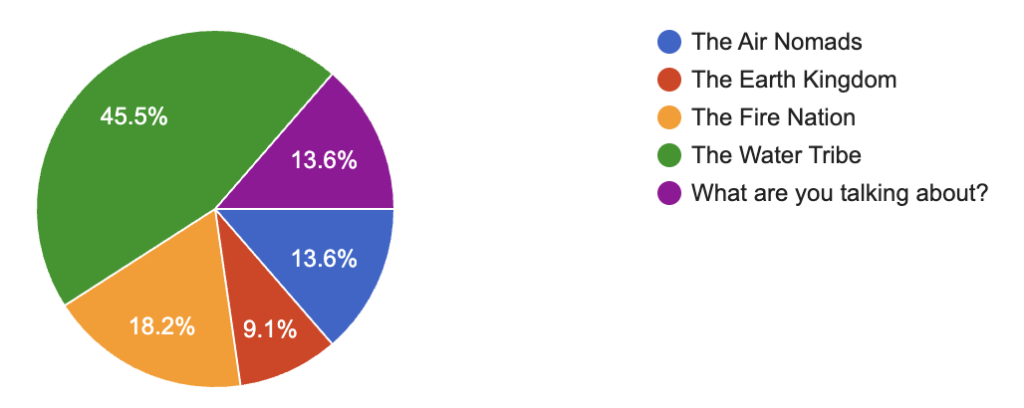
I do informal polling with all of my high school students. Just for kicks. I make up little questionnaires with questions like, “Which starter Pokémon would you choose?” or “Which brand of shoe is chopped?” and I give them to classes as an exit ticket. 75 or 100 students (usually) scan a QR code, which takes them to the poll question on Google Forms, and then I turn their answers into little pie charts or bar graphs and share the results with them at the top of each block.

There isn’t much academic benefit to this activity, but it usually spurs discussion and serves as a way of building up the class as a community. Also, it’s just fun. Very often, students will tell me what kind of poll information they’d like to know and I’ll put it out there for them.

Which of the “bender” kingdoms would you join?

Yesterday I discovered that over 33% of my students self-report as “Night Owls,” or people who feel most productive after midnight. (Most students reported they were most productive in the afternoon, which tracks with national averages, but “Night Owls” came in 2nd.)

It’s not surprising. You would not believe the number of students I see everyday who look absolutely drained. And not just during my first block — a lot of students are (understandably) tired at 7:40 AM (when my first class starts). But some of them are tired before lunch. Some are tired after lunch. Some are tired at 3:05 when they scramble for the exits and beat a hasty retreat back home.

You always hear stories about this in education. “Teenagers need more sleep,” or, “These kids play video games and doomscroll social media all night!”

It’s easy to say, “The kids are lazy,” and write it off, but it’s been my experience that those sorts of easy answers are either oversimplifications or are flat-out wrong.

In this case, probably both. Personally, I think younger people are more likely to be night owls just because they’re young. I was a night owl when I was a kid. As I’ve gotten into middle age, though, I’ve started waking up earlier and earlier, until, now, there are days when I wandomly wake up at 3:00 or 4:00.

The question becomes, “How do I help students who are chronically exhausted?” Sure, you can call parents and send home emails. Talk to admin or counselors to see if we can come up with a plan to help students stay awake, but I think a good first step is to, well, relax. Just chill out about the whole thing.

Calling kids lazy and punishing them for being too tired to participate can’t possibly be the best solution, especially if being a “Night Owl” is a natural part of cognitive development.

Other people probably know more about this; I’m years out of any psychological training. Do you think the desire (or drive) to stay up late is a thing that most teens experience?